About me
Good intentions deserve good outcomes.
I'm Matt. I've spent my career working on energy projects, from power generation to energy efficiency, from project design to productization. This is the longer version of why I do what I do.
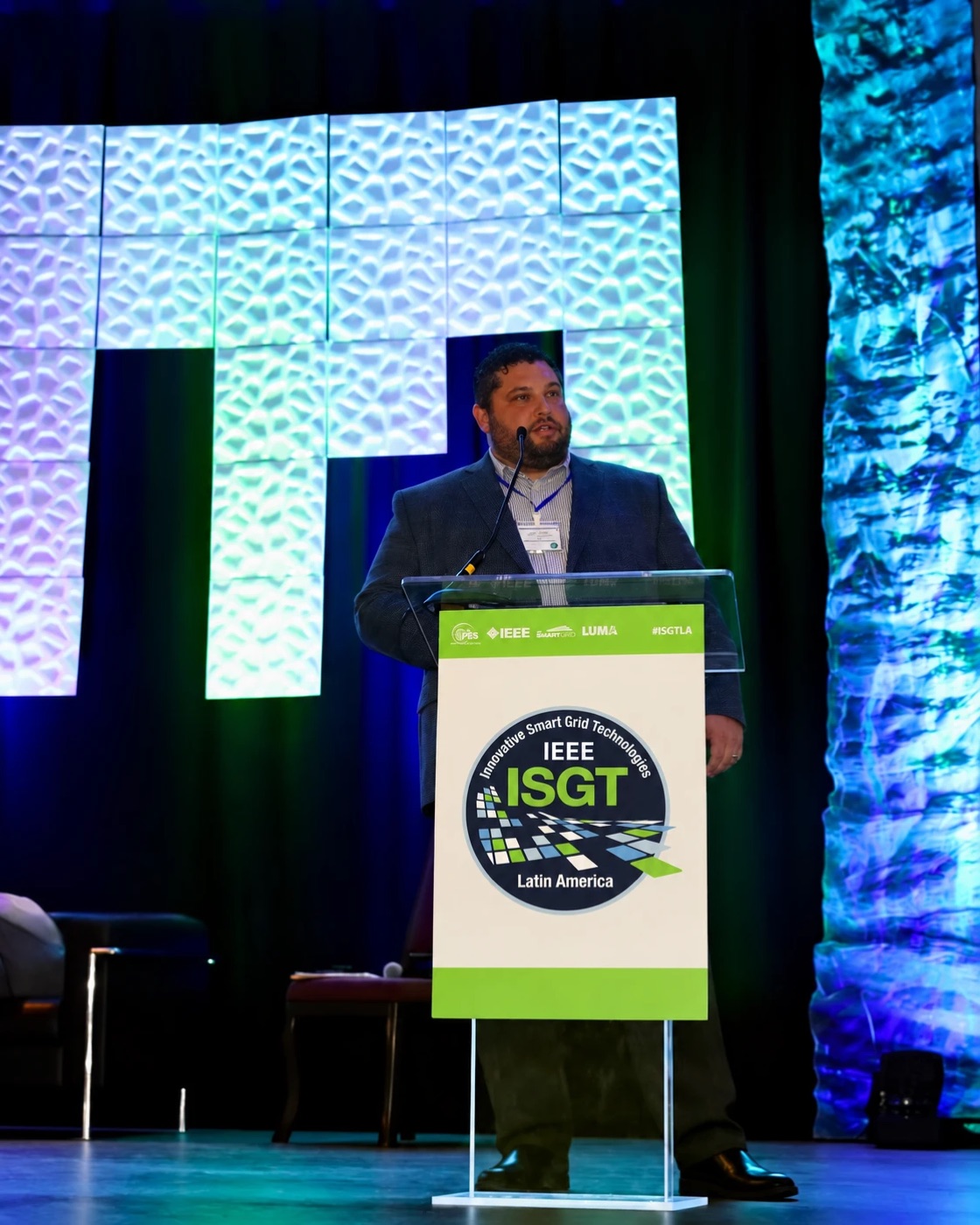
IEEE PES ISGT Latin America, San Juan, 2023.
What I believe
Most people are trying to do the right thing.
Projects don't fail because someone was lazy. They fail because everyone assumed someone else had it covered.
The expensive mistake was cheap once.
Almost every problem I've been called in to fix at commissioning was a line on a page months earlier. Finding it then costs an afternoon.
Say the hard thing before the money moves.
A bad answer early is a favor. A bad answer after the purchase order is a dispute.
Good work should outlast the person who did it.
If a system only runs while I'm standing next to it, I'm not finished.
How I got here
I started hands-on, as a consulting mechanical engineer in Rochester with a services business on the side. That is where I learned that drawings and buildings disagree more often than anyone admits.
Then the owner's side: more than 350 power upgrades and efficiency retrofits for large public and institutional owners, from equipment selection through commissioning. I saw which early decisions came back to bite.
At an energy services company I originated projects that cut operating costs by about a quarter, then founded a battery storage and microgrid business inside it and ran it from first concept to shipped product. Building the thing teaches you what a datasheet leaves out.
Today I hold the technology seat at a battery storage company alongside the independent work this site describes. The job has always been the same: figure out whether a technical decision will hold up once money and reputations are behind it, and say so before anyone signs.
Outcomes
$100M+
in purchases of non-conforming product that customers avoided
$250M+
in energy projects carried from contract to commissioning
8
energy product lines architected, built, or taken to market
8
patent filings in energy storage
Kikuyu, Kenya
Engineering Ministries International · March 2026
I love to fix things. In March 2026 that took me to a hospital outside Nairobi, where I led the electrical master plan for a 250-bed mission hospital that serves half a million people: one utility service instead of three, a ring loop with two paths to every building, solar and battery on the same ring, and a phased path the hospital can fund.
Proposed masterplan at a glance
80+
Buildings
Across two hospital campuses
20 years
Planning horizon
Infrastructure designed for long-term growth
~1.9 MWp
Proposed solar
Rooftop and ground-mounted generation
2.5 MWh
Proposed storage
Battery energy storage system
The fundamental change
Not an engineering drawing. The shapes are the campus in outline, and the lines are the idea: three separate services today, one connected system in the plan.
Where I've spoken
More than 15 talks and panels on storage, microgrids, and public power, including:
- Denver, 2025Experience POWERLong-duration storage panel
- Alaska, 2024NWPPA and APA Alaska Electric Utility ConferenceModular microgrids in remote Alaska
- North Carolina, 2024NC Electric Meter SchoolEnd-of-line public power
- San Juan, 2023IEEE PES ISGT Latin AmericaConference talk